
Assess the spill
Establish the product involved, approximate extent and affected surfaces, including any potential spread beyond the visible area.
Available 24/7Emergency call-out · Speak to a specialist
 SERVICE ILLUSTRATION
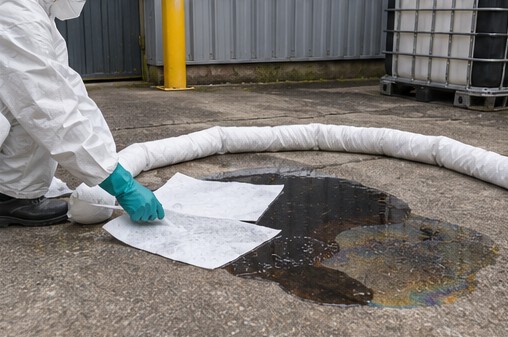
An oil spill must be understood in terms of the product, affected surfaces and potential migration routes. We assess the reported extent, access and site conditions before defining suitable containment, recovery and cleaning work. Where soil, drains or wider environmental impacts are involved, the assessment identifies any additional specialist input or separate investigation required.
Immediate danger or an active fire? Call 999. Mr Flood provides restoration and cleanup, not emergency-service rescue or firefighting.
An oil spill needs an assessment of both the visible deposit and where the material may have travelled. Our team considers the product involved, the source, affected surfaces and nearby drains, soil or water. This distinguishes a localised surface incident from a situation requiring environmental specialist involvement, while helping establish an appropriate containment, recovery and cleaning scope for the property concerned.
Removing visible oil does not necessarily establish that a porous surface or underlying ground is free of contamination. The proposed response therefore separates recoverable material, surface cleaning and any further investigation needed to understand residual effects. We discuss access, waste handling and the limits of the commissioned work so that a practical initial response is not mistaken for a complete contaminated-land assessment or an unconditional environmental clearance.
The precise methods, access requirements and deliverables are agreed for your project. These are the areas we can discuss.
Establish the product involved, approximate extent and affected surfaces, including any potential spread beyond the visible area.
Plan appropriate specialist containment and recovery methods for the location, access and contamination identified on site.
Consider surface cleaning, affected materials and waste-handling needs, identifying when further environmental specialist input is required.
Methods are selected for the materials, conditions and agreed purpose of the visit.
Gather the available incident details and product information, then assess accessible affected areas and potential migration routes. The source status and any uncertainty about drains or ground involvement are highlighted, with relevant reporting or specialist advice identified where pollution may be involved.
Choose an approach appropriate to the substance, location and site conditions, with the objective of controlling spread and recovering contamination. The work is not treated as ordinary wash-down cleaning that could simply move oily residue into drainage or surrounding ground.
Review remaining surface contamination and the need for further specialist assessment. Any sampling, environmental investigation or validation is defined as its own scope, with appropriate competence and interpretation, rather than assuming a cleaner appearance proves the entire incident has been resolved.
The quotation confirms the work and any reporting or verification included. These are the outputs to discuss.
An agreed initial response scope with affected areas and uncertainties identified.
A record of containment, recovery and cleaning carried out within that scope.
Waste-route information and recommendations for any further environmental assessment.
Useful terms you may see in the specification or findings.
No. The product, spread and affected environment determine the response. Some incidents need additional environmental specialists or authority involvement beyond a cleaning quotation.
Not always. Surface appearance does not show the condition of concealed materials or ground. Where the assessment identifies that concern, further investigation or specialist validation is recommended separately from the initial cleaning work.
That needs prompt pollution-response consideration, not a routine cleaning appointment alone. In England, potential water or ground pollution should be reported through the Environment Agency’s appropriate incident route, alongside arranging relevant specialist assistance.
Mr Flood supports homeowners, landlords, managing agents and commercial clients. The scope, quotation and any reporting requirements are discussed for the individual job.
Read customer reviewsSend the postcode, a short description and photos where safe. We’ll help identify the appropriate next step.
No automatic booking or commitment.
 Amy · Mr FloodFind your service
Need help choosing a service? Browse all services or email the Mr Flood team.