

Choose meaningful locations
Agree the surfaces, timing and purpose of the checks so the results relate to the cleaning question.
Available 24/7Emergency call-out · Speak to a specialist
 SERVICE ILLUSTRATION
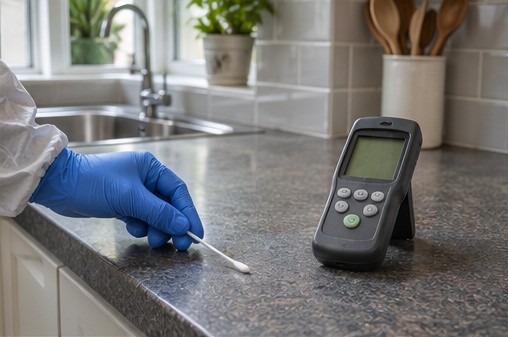
ATP hygiene monitoring adds a recorded surface check to an agreed cleaning programme. We define the sampling locations and test conditions, follow the instrument’s protocol and interpret results within that method. Readings can guide targeted re-cleaning and comparable retesting; they do not identify mould or pathogens, establish sterility or certify a surface as safe.
ATP testing makes a defined surface-cleaning check measurable. A swab collects residue from an agreed area, and a luminometer measures the light produced by the test reaction. The result is expressed in relative light units. This can help identify where cleaning needs review, but it does not identify a particular organism or replace laboratory microbiological analysis where that is the question being asked.
Useful results come from a consistent protocol, not an isolated number with no context. Surface choice, swabbed area, test timing, products used and the selected instrument all matter. We agree the purpose and interpretation approach before sampling, then record the findings in a way that supports corrective cleaning and meaningful follow-up. ATP testing complements a cleaning programme; it is not a certificate that a site is pathogen-free.
The precise methods, access requirements and deliverables are agreed for your project. These are the areas we can discuss.
Agree the surfaces, timing and purpose of the checks so the results relate to the cleaning question.
Collect surface swabs and record instrument readings with the location and relevant sampling details for comparison.
Explain the readings against the agreed protocol, noting areas for further cleaning or a separately arranged recheck.
Methods are selected for the materials, conditions and agreed purpose of the visit.
Identify relevant contact points or cleaned surfaces and agree whether the check is before cleaning, after cleaning or part of a repeat programme. Confirm the test system and applicable interpretation protocol. Results from different instruments or unrelated surface types should not be casually compared.
Use the selected test method at the agreed locations, recording identifiers, timing and relevant cleaning information. Take care to maintain a consistent sampling approach. The instrument reading is linked to that defined location rather than presented as a measure of cleanliness throughout the entire room.
Review results against the agreed system-specific protocol, identify areas needing further cleaning and arrange retesting where included. Explain unexpected results in context. Where pathogen identification or microbiological verification is required, discuss an appropriate separate testing method rather than infer it from ATP.
The quotation confirms the work and any reporting or verification included. These are the outputs to discuss.
An agreed surface list and sampling protocol.
Location-referenced ATP readings with relevant test conditions.
A corrective-cleaning and retest record where included.
Useful terms you may see in the specification or findings.
No. ATP is a cleanliness indicator associated with organic residue; it is not a pathogen-identification test or a stand-alone guarantee of disinfection or safety.
Yes, where that is the agreed monitoring purpose. Use a consistent test system, defined sampling locations and comparable timing, following the test instructions and allowing for possible cleaning-product interference. The comparison supports assessment of the sampled surfaces rather than proving the condition of an entire property.
No. Interpretation depends on the test system and agreed monitoring protocol. Consistent sampling and a relevant baseline make repeated results more useful than applying a number borrowed from another instrument, industry or surface.
Mr Flood supports homeowners, landlords, managing agents and commercial clients. The scope, quotation and any reporting requirements are discussed for the individual job.
Read customer reviewsSend the postcode, a short description and photos where safe. We’ll help identify the appropriate next step.
No automatic booking or commitment.
 Amy · Mr FloodFind your service
Need help choosing a service? Browse all services or email the Mr Flood team.