

Rising and penetrating damp
Assess the cause before considering appropriate DPC treatments, defect repairs, membranes or protective finishes for the affected construction.
Available 24/7Emergency call-out · Speak to a specialist
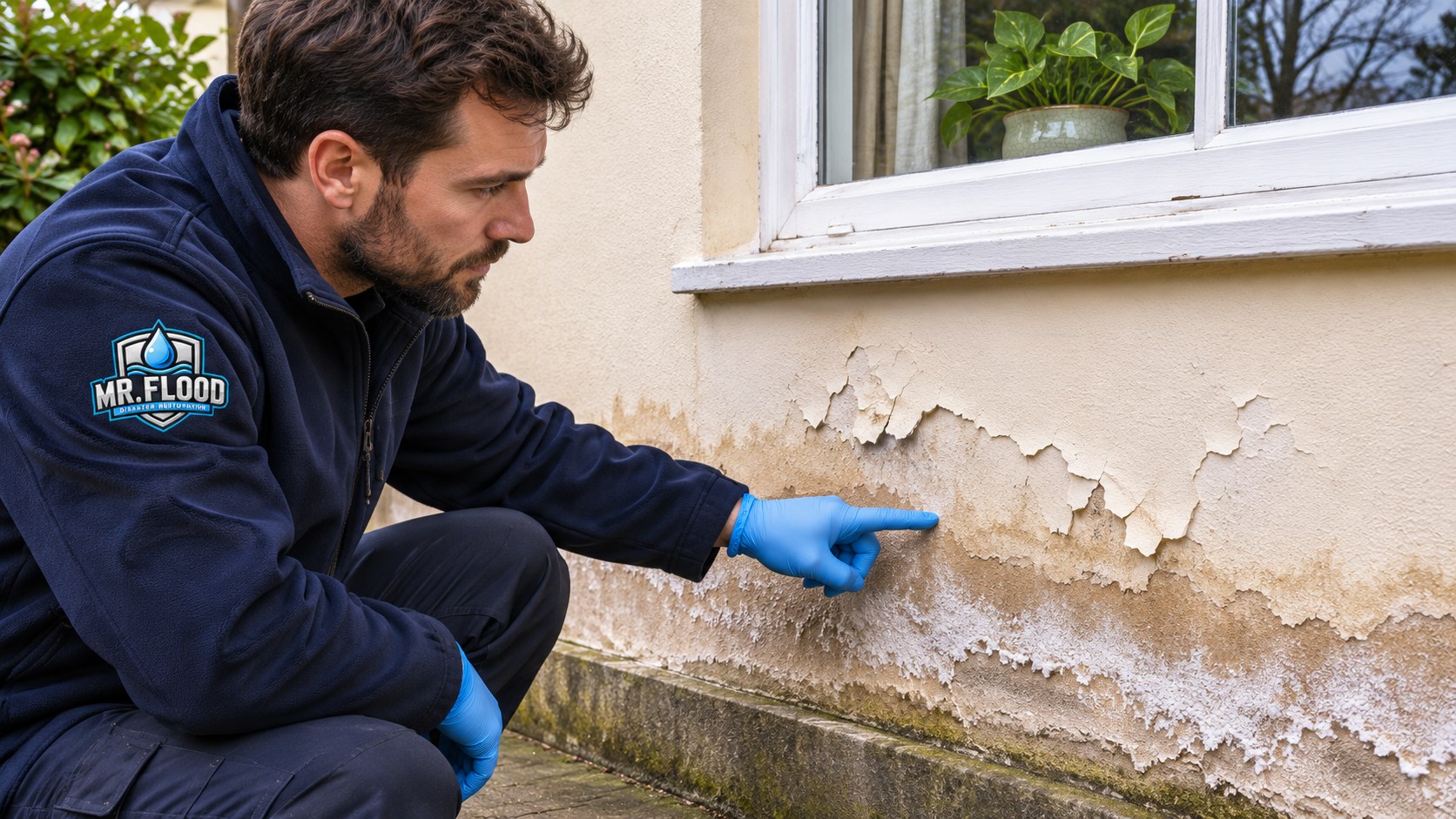 SERVICE ILLUSTRATION
Effective damp-proofing work starts with the moisture mechanism and the building’s construction. We assess the evidence for rising or penetrating damp, condensation and below-ground water ingress before recommending an appropriate approach. The resulting scope explains the proposed treatment, necessary preparation and related repairs, rather than treating every damp patch as the same defect.
Damp proofing begins with a careful assessment of the likely moisture route and any remaining uncertainty. Ground moisture, rainfall penetration, plumbing leaks and condensation can produce overlapping symptoms but require different responses. The building’s age, wall construction, external ground levels, drainage and existing finishes all matter. Our approach is to identify the evidence and select proportionate remedial measures, rather than make injection or tanking the default answer.
A remedial plan may involve defect repairs, an appropriate damp-proof course, membranes, compatible plaster or finishes, ventilation improvements or a separately defined below-ground waterproofing scheme. These are options to assess, not interchangeable treatments. Liquid chemical DPC injection is an option only where the evidence, construction and selected product are suitable; it is never assumed necessary from a stain or isolated meter reading. Traditional solid-wall buildings need particular attention to how their materials absorb and release moisture. The proposed system and reinstatement sequence must suit the construction and the actual moisture mechanism.
The precise methods, access requirements and deliverables are agreed for your project. These are the areas we can discuss.
Assess the cause before considering appropriate DPC treatments, defect repairs, membranes or protective finishes for the affected construction.
Consider the relationship between indoor moisture, air movement and cold surfaces when discussing practical condensation-control measures.
Discuss suitable basement or cellar waterproofing, affected plaster and finishes as part of the agreed remedial scope.
Methods are selected for the materials, conditions and agreed purpose of the visit.
Review accessible moisture patterns, building history and relevant external defects before discussing a system. Compare evidence for ground moisture, rainwater entry and condensation, recognising that more than one may be present. A high electrical meter reading alone is not a diagnosis of rising damp.
Explain the proposed intervention, the affected construction and why it suits the findings. Consider connections with adjoining floors, walls and existing finishes. Below-ground work requires a defined waterproofing brief; a coating applied to an isolated patch should not be presented as a complete basement solution.
Set out the preparation, material removal and finishes included in the agreed work. Source control does not instantly remove existing moisture, so drying and monitoring may still be needed. Replastering and decoration are coordinated with substrate condition and the requirements of the selected materials.
The quotation confirms the work and any reporting or verification included. These are the outputs to discuss.
An evidence-led remedial scope with proposed system rationale.
Clear preparation, access and reinstatement requirements.
Product-specific care and follow-up information where applicable.
Useful terms you may see in the specification or findings.
No. Construction, condition and the route of moisture all matter. The proposed treatment is selected after assessment, not from a damp patch alone.
No. Staining and salts can reflect several moisture histories. Construction details, distribution, external conditions and appropriate investigation are considered together before recommending a damp-proof course or another remedial system.
That depends on the cause and the substrate. A finish may form part of an appropriate system, but covering a damp patch does not establish or repair the route by which moisture is entering.
Mr Flood supports homeowners, landlords, managing agents and commercial clients. The scope, quotation and any reporting requirements are discussed for the individual job.
Read customer reviewsSend the postcode, a short description and photos where safe. We’ll help identify the appropriate next step.
No automatic booking or commitment.
 Amy · Mr FloodFind your service
Need help choosing a service? Browse all services or email the Mr Flood team.