

Review the history
Consider when moisture appears, previous repairs and adjoining rooms or services to guide the investigation.
Available 24/7Emergency call-out · Speak to a specialist
 SERVICE ILLUSTRATION
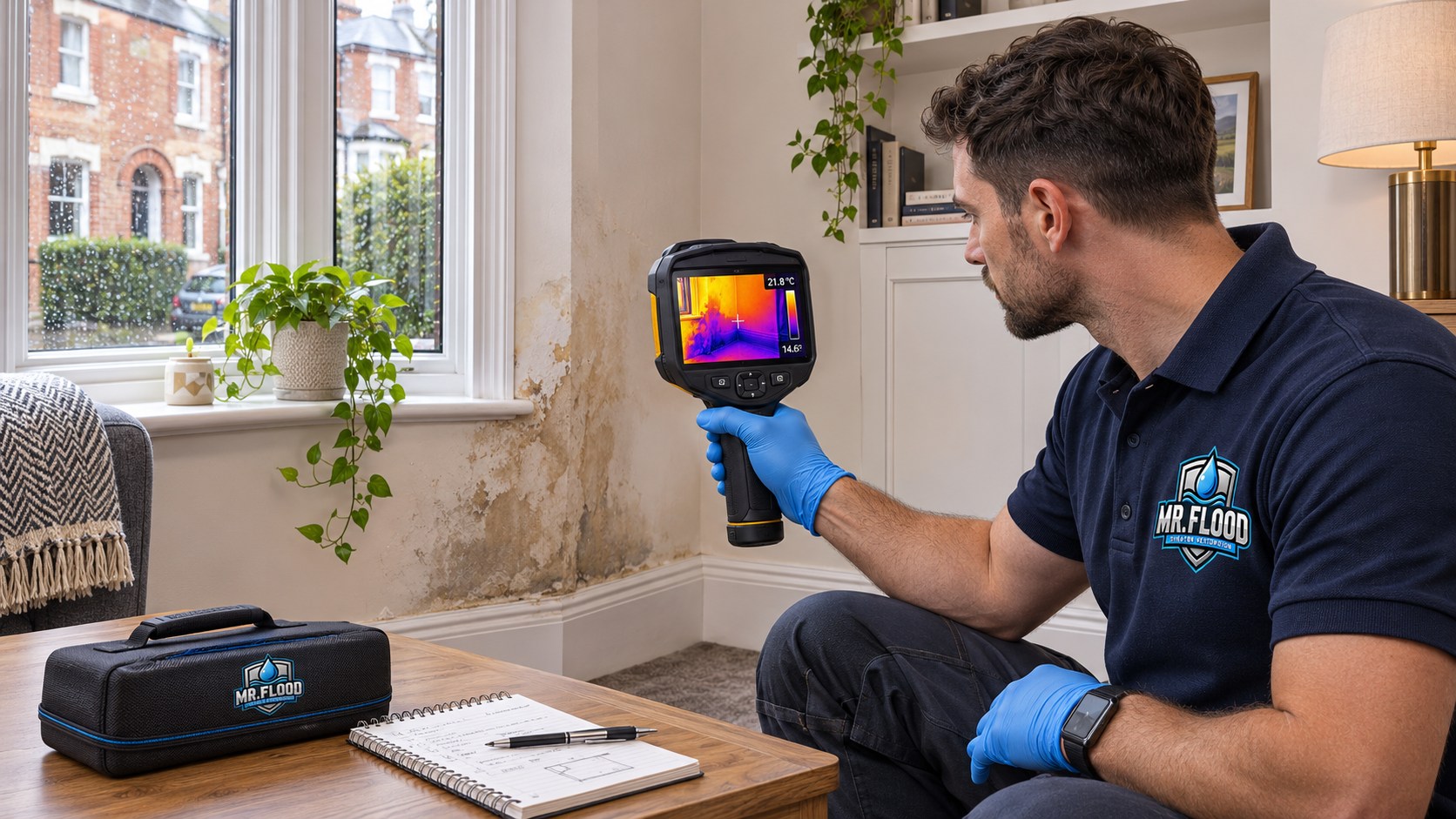
The visible damp patch is not always close to the source. We combine the incident history, accessible moisture patterns and useful thermal observations to investigate likely water-migration routes. Findings explain the evidence, remaining uncertainty and any agreed trace-and-access or further testing needed. Plumbing repair and installation remain separate from our investigation, drying and reinstatement services.
Water does not always become visible directly beneath its source. It can follow interfaces, services and construction layers before emerging as staining or a damp floor. A focused investigation considers that possible route alongside the timing of the problem, adjoining rooms and earlier repairs. We aim to narrow the evidence-led search area and explain what is known, rather than promise an exact concealed source from one instrument reading.
Accessible moisture checks and thermal imaging, where useful, help build the investigation picture. The thermal camera displays surface temperature patterns; it does not look through walls or identify every leak. Evidence may justify a targeted trace-and-access proposal or referral to the appropriate repair trade. Any opening-up is separately agreed, and plumbing repair or installation is not included in our investigation service. An agreed investigation can include moisture concerns in basements and cellars, beneath floors where access is authorised, and around underfloor heating or radiator systems. Access restrictions and any separately specified system tests are recorded. Investigation does not include plumbing repairs, and below-ground moisture does not automatically call for tanking or damp-proof injection.
These are scope options, not automatic inclusions in every visit. The relevant tasks, access, specialist attendance and responsibilities are agreed before booking the work.
Where the investigation calls for them, acoustic listening, pressure testing, tracer gas or dye tracing can be considered as separately specified diagnostic stages. Suitability, access, equipment and competent specialist attendance are confirmed for the actual system; these methods are not automatically included in a standard damp and moisture survey.
A drainage CCTV survey or drain-cleaning stage may be appropriate where the evidence concerns a drain rather than a building surface. Its inspection extent, access and any specialist arrangements are agreed separately. Mr Flood’s moisture investigation and restoration do not include plumbing repair or installation.
The precise methods, access requirements and deliverables are agreed for your project. These are the areas we can discuss.
Consider when moisture appears, previous repairs and adjoining rooms or services to guide the investigation.
Use suitable moisture checks and thermal imaging where useful, with any further investigative methods agreed for the circumstances.
Explain the evidence, limitations and recommended next steps, including trace-and-access needs or referral for the source repair.
Methods are selected for the materials, conditions and agreed purpose of the visit.
Review whether moisture is constant, follows rainfall or relates to use of nearby facilities. Note repairs, adjoining rooms and areas above or below. Photographs from earlier episodes can help distinguish an active pattern from a stain left by a resolved incident.
Map relevant moisture indications and compare them with appropriate reference areas, accounting for materials and meter mode. Use thermal observations where conditions make them informative. Findings from separate methods are considered together; an unusual thermal pattern alone is not treated as confirmation of leaking pipework.
Explain likely routes, alternative explanations and areas that could not be assessed. Where access is needed, propose a targeted location and purpose before any opening is authorised. Following source repair, moisture assessment and drying may still be needed before the damaged finishes are reinstated.
The quotation confirms the work and any reporting or verification included. These are the outputs to discuss.
An agreed photographic findings record identifying the accessible areas investigated.
A moisture-pattern assessment distinguishing observed evidence, likely routes and remaining uncertainty.
Targeted next steps for authorised access, separately arranged source repair and any necessary drying.
Useful terms you may see in the specification or findings.
No. Our scope is investigation, trace and access where agreed, drying and reinstatement. Plumbing repair or installation needs to be arranged separately.
Yes, within an agreed brief. The reported timing and earlier photographs are particularly useful. An intermittent source may not be active during inspection, so additional monitoring, coordinated access or a return assessment may be required.
Materials may retain moisture after a successful repair, but continuing ingress is another possibility. Comparing the condition and subsequent readings helps distinguish drying progress from a problem that still needs investigation; appearance alone cannot settle that question.
Mr Flood supports homeowners, landlords, managing agents and commercial clients. The scope, quotation and any reporting requirements are discussed for the individual job.
Read customer reviewsSend the postcode, a short description and photos where safe. We’ll help identify the appropriate next step.
No automatic booking or commitment.
 Amy · Mr FloodFind your service
Need help choosing a service? Browse all services or email the Mr Flood team.