

Define the test scope
Clarify the concern and the substances or conditions of interest rather than promising one test for every contaminant.
Available 24/7Emergency call-out · Speak to a specialist
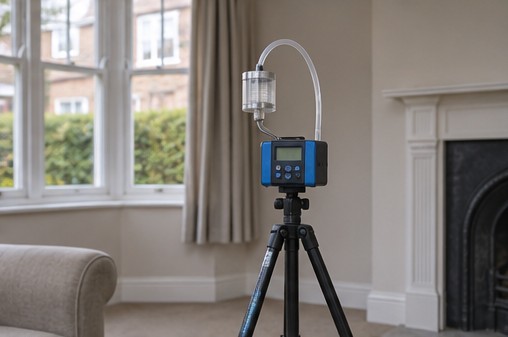 SERVICE ILLUSTRATION
An informative air-quality assessment starts with the property concern and the question to be answered. We agree suitable measurements or sampling, consider occupancy and ventilation conditions, and record the context needed to interpret the results. The findings explain the assessed parameters, limitations and practical next steps without presenting one test as a complete assessment of every airborne hazard.
An indoor-air investigation needs to begin with the concern, not a promise to test for everything. A ventilation question, an airborne-particle concern and a request for fungal sampling require different methods and interpretations. We discuss the building history, room use and any relevant incident before confirming which parameters can be assessed within an appropriate, specifically agreed sampling or measurement brief.
Conditions during collection are part of the result. Occupancy, ventilation, cleaning, weather and recent works may all influence what is measured. Short observations and longer monitoring answer different questions, while some substances need a targeted laboratory method. The findings are therefore explained with their timing, scope and limitations, helping you decide on the next building-management or specialist investigation step without implying a complete health assessment.
The precise methods, access requirements and deliverables are agreed for your project. These are the areas we can discuss.
Clarify the concern and the substances or conditions of interest rather than promising one test for every contaminant.
Take the appropriate readings or samples at agreed locations, recording the conditions and relevant limitations.
Present results within the agreed test scope, with recommendations for further investigation or property-management measures where appropriate.
Methods are selected for the materials, conditions and agreed purpose of the visit.
Clarify whether the enquiry concerns ventilation, a known source, particles or an agreed biological sample. Confirm the available instrument or laboratory method, locations and reporting scope before attendance. Specific gases and vapours are not assumed covered simply because a device is described as an air-quality monitor.
Choose locations and timing that relate to the agreed objective, documenting occupancy, ventilation and relevant activities. Avoid presenting a brief reading in an empty room as a full picture of normal use. Where longer monitoring or comparison samples are needed, define those as part of the plan.
Explain each reported parameter and what it can and cannot indicate. Carbon dioxide may help assess ventilation in suitable occupied spaces, but it does not measure every pollutant or prove an environment is safe. Recommendations relate to the evidence and identify any additional specialist testing needed.
The quotation confirms the work and any reporting or verification included. These are the outputs to discuss.
A confirmed parameter list, collection method and sampling scope.
Results linked to locations, timing and relevant conditions.
A contextual findings summary and proportionate next steps.
Useful terms you may see in the specification or findings.
No. Different tests assess different parameters, and results reflect the sampling conditions. The testing brief should be agreed before attendance; results are not a medical diagnosis.
No. Carbon dioxide is a different measurement from fungal sampling, particle assessment or targeted chemical testing. The relevant test is chosen for the concern; a result for one parameter cannot clear all the others.
No. The report documents the agreed environmental assessment, not a clinical diagnosis or proof of individual exposure. A medical professional addresses symptoms, while any additional property testing needs a defined question and suitable method.
Mr Flood supports homeowners, landlords, managing agents and commercial clients. The scope, quotation and any reporting requirements are discussed for the individual job.
Read customer reviewsSend the postcode, a short description and photos where safe. We’ll help identify the appropriate next step.
No automatic booking or commitment.
 Amy · Mr FloodFind your service
Need help choosing a service? Browse all services or email the Mr Flood team.