
Establish a baseline
Record moisture and environmental conditions to understand the affected areas and inform the proposed drying approach.
Available 24/7Emergency call-out · Speak to a specialist
 SERVICE ILLUSTRATION
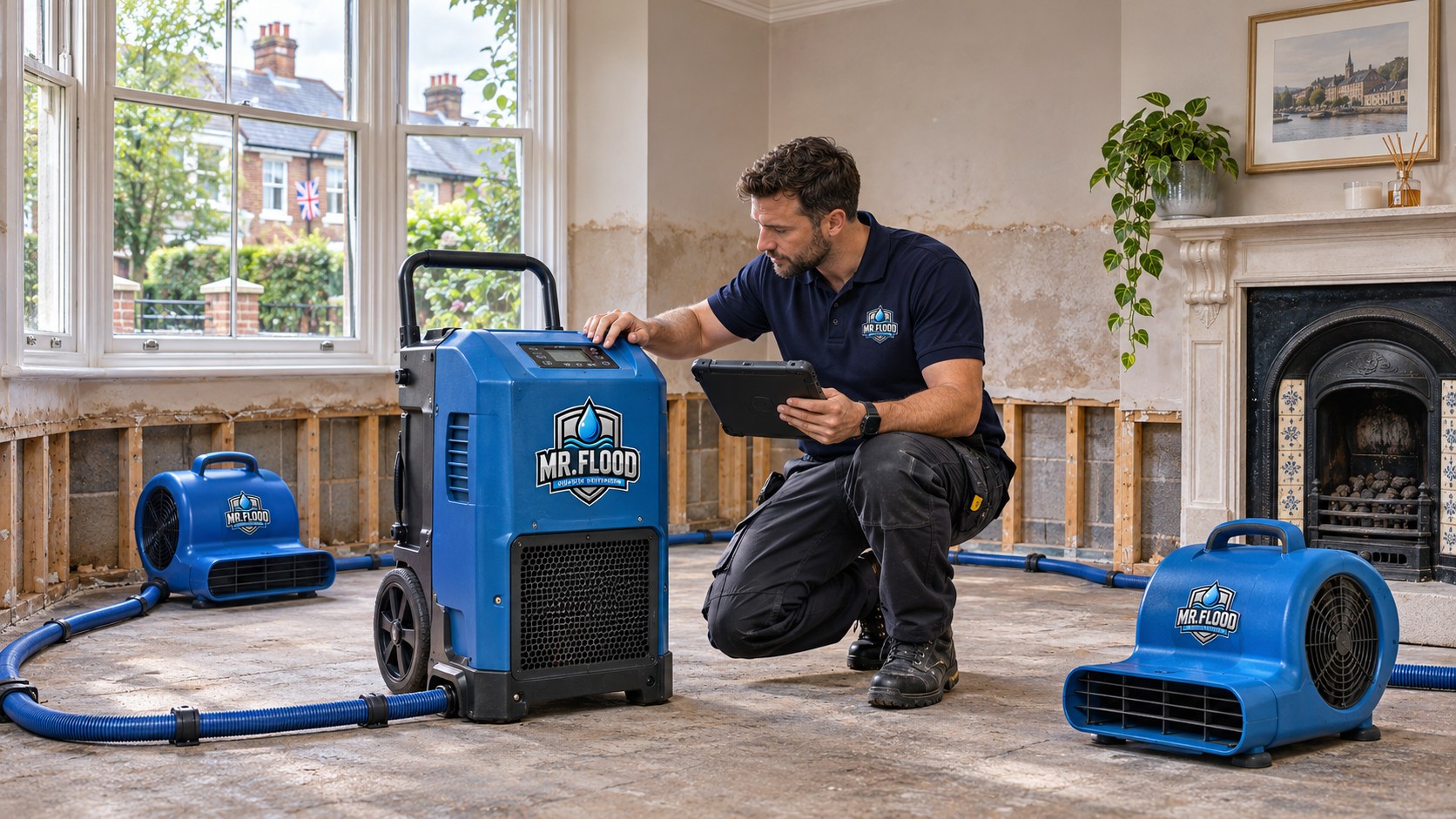
Drying is a measured process, not a judgement made from appearance alone. We establish moisture and environmental baselines, consider how the affected materials are constructed and select a suitable drying strategy. Repeat readings track the response, guide equipment adjustments and support a documented decision about the next stage of reinstatement.
Immediate danger or an active fire? Call 999. Mr Flood provides restoration and cleanup, not emergency-service rescue or firefighting.
Effective drying is a measured process involving both the building and the surrounding air. Different floor layers, wall finishes and structural materials release moisture at different rates. We establish accessible moisture conditions, environmental readings and suitable reference points before selecting equipment. The aim is to create an appropriate drying environment and assess progress, rather than judge completion from a surface touch or a machine running overnight.
Refrigerant or desiccant dehumidification, controlled air movement and specialist access methods are considered according to the construction and site conditions. Cavity or injection drying may be appropriate for an agreed scope, but opening-up and new holes are not assumed to be included. Monitoring explains whether conditions are improving, whether adjustments are needed and what evidence supports the next stage of repair. Vehicle drying can also be considered where suitability and access are established for the affected interior and materials. Any dismantling, mechanical or electrical assessment is separately agreed with the appropriate specialist; a dry surface does not establish that a vehicle or its electrical systems are safe to use.
The precise methods, access requirements and deliverables are agreed for your project. These are the areas we can discuss.
Record moisture and environmental conditions to understand the affected areas and inform the proposed drying approach.
Consider dehumidification, air movement and specialist drying methods according to the materials, construction and site conditions.
Review readings and drying progress, documenting the agreed areas and any further work needed before reinstatement.
Methods are selected for the materials, conditions and agreed purpose of the visit.
Identify the accessible affected materials and record repeatable measurement locations. Select the instrument mode and interpretation appropriate to each substrate, using suitable comparison areas where available. Temperature and relative humidity help describe the environment; readings from different materials are not treated as interchangeable percentages.
Position agreed dehumidification and air-movement equipment around the drying objective, access and contamination status. Review enclosure, drainage and occupancy arrangements. The setup should encourage moisture removal from the affected materials while keeping operational instructions and any access restrictions clear to the occupier.
Compare subsequent readings with the baseline and relevant reference conditions, recording equipment adjustments and any stalled progress. Completion criteria depend on the material and intended finish. A drying record supports the decision; it does not replace a flooring manufacturer’s specified test or a separate structural assessment.
The quotation confirms the work and any reporting or verification included. These are the outputs to discuss.
An agreed equipment plan and practical operating instructions.
Repeatable baseline and monitoring records for agreed accessible materials and locations.
A completion record or scoped dryness certificate, where agreed, stating the assessed areas and limitations.
Useful terms you may see in the specification or findings.
It depends on the materials, extent of wetting, access and environmental conditions. The drying plan is reviewed against measurements rather than a fixed number of days.
No. Instrument scale, material, construction and proposed finish all matter. Completion uses appropriate criteria and evidence for the agreed area, not a universal number applied to plaster, timber and concrete alike.
Only the scope and evidence stated in the document. Restricted or untested areas must remain identified. If a concealed layer needs confirmation, additional access or a different material-specific test may be proposed separately.
Mr Flood supports homeowners, landlords, managing agents and commercial clients. The scope, quotation and any reporting requirements are discussed for the individual job.
Read customer reviewsSend the postcode, a short description and photos where safe. We’ll help identify the appropriate next step.
No automatic booking or commitment.
 Amy · Mr FloodFind your service
Need help choosing a service? Browse all services or email the Mr Flood team.